
Learning how to become an RN requires three main steps. First, you’ll need to earn your nursing degree. A nursing school program consists of coursework combined with experiential learning components, like labs and clinical rotations. Then, you’ll need to pass the NCLEX-RN. Finally, obtain licensure from your state.

There is no universal pathway for determining how to become an RN, as people can enter the nursing field from a variety of backgrounds and stages of life. The timeline can also vary. Regardless of which RN steps you take, however, you’ll still need to meet the basic requirements to become a registered nurse: earning a nursing degree and obtaining state licensure.
If you’re interested in a shorter pathway to nursing and have a non-nursing bachelor’s degree or college credits, you may be eligible for Harding University’s accelerated Bachelor of Science in nursing program. Our ABSN enables you to graduate in as few as 16 months with a Bachelor of Science in Nursing after completing prerequisite courses.
Before starting the admissions process, explore what’s required to become a registered nurse. Learn which nursing degree is best for your career goals and discover how long it takes to become an RN.
RN Steps: What It Takes to Become a Registered Nurse
There are multiple pathways one could take to become an RN, but all pathways include two basic requirements:
- A nursing degree
- A nursing license
Every type of nursing program includes both didactic coursework and hands-on, immersive learning experiences. This is necessary to teach nurse candidates about nursing concepts and theories, fundamental clinical skills and the clinical judgment needed to practice as an RN.
After graduation, nurse candidates must pass the NCLEX-RN exam to obtain a state-issued RN license. The exam tests nursing knowledge, critical thinking and clinical judgment.

Do these top reasons to become a nurse resonate with you?
Choosing the Right Nursing Degree for Your Goals
There are two main types of nursing programs you could enroll in to become an RN. The first is the Associate Degree in Nursing. An ADN typically takes two years to complete and can be appropriate for students who wish to start working fast; however, the curriculum is not as comprehensive as baccalaureate programs.
The second option is the BSN degree. Compared to the ADN, the BSN offers more intensive clinical learning experiences and has more time to provide a comprehensive curriculum that better prepares nurses to handle complex care scenarios. It also emphasizes critical thinking, clinical judgment and nursing leadership.
As a result, BSN-prepared nurses tend to contribute to better patient outcomes. They can also pursue graduate-level nursing education and career advancement.
How Long It Takes to Become an RN: Accelerated Paths to Consider
As mentioned before, a typical ADN program takes two years to complete. A traditional BSN takes four years of full-time study. For individuals with a non-nursing bachelor’s degree or college credits, accelerated pathways allow them to earn a BSN quickly, typically under two years.
If you’d like to earn a BSN faster, you might meet the admission requirements for an ABSN program. At Harding, individuals with a non-nursing bachelor’s degree or at least 64 college credits can earn a BSN in as few as 16 months, after completing prerequisites. After graduating, you could take the NCLEX-RN within a couple of months.
Step 1: Earn a Nursing Degree Through an Accredited Program
First, find the nursing program that’s right for you. If you have a non-nursing college education, you might be eligible for an accelerated nursing program, such as Harding’s ABSN program. If not, a traditional ADN or BSN program might be right for you.
Be sure to review the program’s accreditation from either the Commission on Collegiate Nursing Education or the Accreditation Commission for Education in Nursing. For example, Harding’s ABSN program is accredited by the CCNE and is fully approved by the Arkansas State Board of Nursing.
Nursing School Curriculum
It is also helpful to review a program’s curriculum to ensure it aligns with your education and career goals. Harding’s ABSN curriculum consists of online coursework blended with experiential learning components: nursing skills labs, simulation labs and clinical rotations. The curriculum explores key topics in nursing, including:
- Community health nursing
- Gerontological nursing
- Health assessments
- Medical-surgical nursing
- Nursing practice interventions
- Nursing research
- Pharmacology
- Psychiatric and mental health
Nursing Skills and Simulation Labs
Students also participate in nursing labs where they first experience applying foundational nursing skills in a simulated setting. There are two types of labs: nursing skills labs and simulation labs.
Nursing skills labs teach patient care tasks. These include inserting IV lines and conducting patient assessments. Meanwhile, simulation labs mimic actual patient care scenarios, so you can practice what to do and how to do it without risking harm to a real patient. Simulation labs also teach critical thinking and clinical judgment.
Clinical Rotations
In addition to labs, you’ll complete a series of clinical rotations at nearby health care facilities. You’ll provide direct patient care under the supervision of a clinical instructor. It’s one of the most important steps to becoming an RN, as you’ll experience real-world clinical situations, develop a professional demeanor, learn time management skills and start building a professional network.
Clinical rotations are available in nursing specialties such as:
- Adult health
- Community health
- Mental health
- Obstetrics
- Pediatrics
What are nursing clinicals like? Learn what you can expect from these experiences.

Step 2: Pass the NCLEX-RN and Meet Licensure Requirements
During your time in the ABSN program, you’ll study and prepare for the NCLEX-RN. Passing this rigorous exam is required to obtain RN licensure. You can retake the exam if needed, but it’s ideal to pass it on the first attempt. Nurse candidates typically take the NCLEX-RN within two months of graduating so that the material is top of mind.
After passing the NCLEX-RN, you can apply for nursing licensure from your state board of nursing. If you take the NCLEX-RN in Arkansas, however, it may be possible to start working as a nurse before receiving your NCLEX-RN results.
The Arkansas State BON allows nursing school graduates to apply for a temporary permit to work between graduation and receipt of their NCLEX-RN results.
Temporary permits aside, you’ll still need to apply for an official nursing license after passing the NCLEX-RN. Each state establishes its own application process. In Arkansas, you must apply via the online portal and submit your official transcripts to the licensure board’s ABSN office.
Note that you will not receive a paper copy of your license in Arkansas. Instead, you can verify your licensure status online through the National Council of States Board of Nursing.
Step 3: Start Your Career as a Registered Nurse
The next step is to start practicing as a licensed RN. Look for nursing jobs in your specialty if you haven’t already done so. If you made a good impression at health care facilities during your clinical rotations, you may lean into your professional network for help in the job marketplace.
Is Becoming an RN the Right Next Step for You?
Only you can determine if becoming an RN is the right choice for you. Consider the following questions:
- Are you interested in a well-paying job with strong job growth?
- Can you commit to being a lifelong learner?
- Do you enjoy working closely with people?
- Are you a team player?
- Are you able to handle exposure to body fluids and pathogens?
- Do you have compassion, empathy, attention to detail, communication skills and other important traits for a nurse?
If you’re still unsure, consider seeking job shadowing opportunities or volunteer positions in a health care setting to get a firsthand look at this career field.
How to Become an RN Quickly at Harding
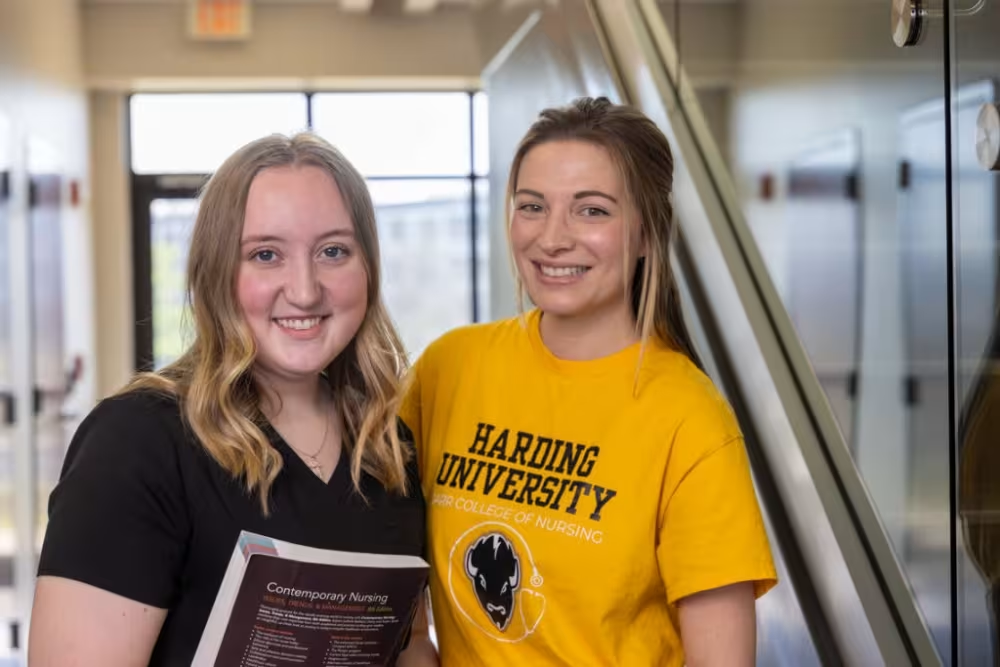
At Harding University, you can earn a BSN faster than traditional programs, preparing you to enter the workforce sooner. We offer a values-based curriculum, accelerated time to graduation, convenient online coursework and immersive clinical experiences. With small class sizes, experienced nursing instructors, and dedicated admissions counselors, students are supported throughout their education from the application process to graduation.
Request info today and take the first step to becoming a nurse with Harding University’s ABSN program.