
What are nursing clinicals? Nursing school clinicals provide the opportunity to put your nursing skills and knowledge to the test in a live patient setting. Knowing what to expect during your clinical placements and being prepared will help you optimize your time and learn from the experience.
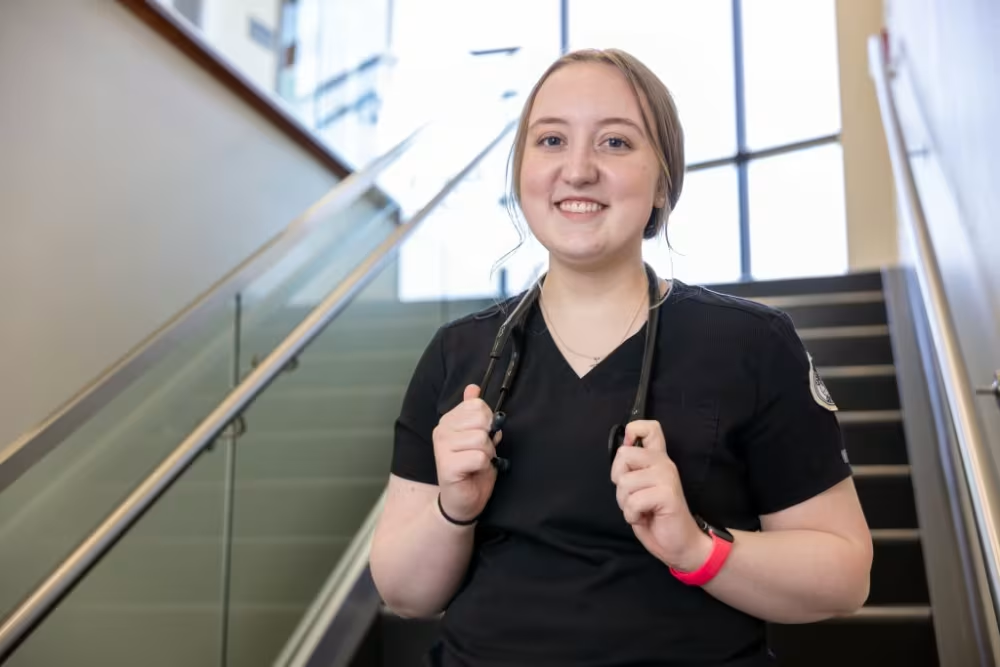
Once you’re accepted to nursing school, it’s important to take a closer look at the curriculum and different learning components so you understand what to expect. In addition to nursing coursework and in-person labs, nursing school clinicals are required as part of the curriculum. What are nursing clinicals? They enable you to put knowledge into practice and start caring for real patients while under supervision.
At Harding University, our accelerated Bachelor of Science in nursing program provides clinical placements with Mercy Hospital Northwest, Vantage Point Behavioral Health Hospital and Arkansas Children’s Hospital to prepare our graduates to tackle complex patient care challenges. You’ll have opportunities for academic, professional and personal growth as you navigate toward your nursing career.
Before attending nursing school, take a closer look at what clinicals are and why they’re important. Then, get the answers to some common questions, such as, “How long are nursing clinicals?” and “How can I prepare for clinicals?”
What Are Clinicals in Nursing School?
Clinical rotations are in-person, hands-on learning experiences that take place in health care facilities. Students work shifts alongside experienced nurses while under the supervision of their clinical instructor. During clinicals, nursing students provide care to patients, first starting with simple nursing tasks and working up to more complex care scenarios.
Why Are Clinicals in Nursing School Important?
The nursing coursework provides thorough preparation for understanding nursing concepts, such as patient assessment and medication management, but becoming a nurse requires more than just coursework. It requires hands-on skills training and clinical experience.
Nursing school clinicals provide that essential experience, allowing students to practice interacting with patients professionally, placing IV lines, operating medical equipment, charting and other nursing tasks.
Thinking about attending nursing school out of state? Discover why Arkansas is worth it.

How Long Are Nursing Clinicals?
Your school determines the number of nursing clinical hours required for graduation. The number of clinical hours is partially dependent on factors like a facility’s operating hours and personal constraints. Students must also complete clinical hours in simulations and skills labs.
The primary nursing certification organization, the National Council of State Boards of Nursing, requires graduation and satisfactory completion from an accredited nursing school but does not specify the number of clinical hours.
Another regulator of the number of nursing clinical hours will be the state’s board of nursing where you live or plan to work. The clinical hours requirement varies from state to state and is often around 200 clinical hours.
How long are nursing clinical shifts? Although it can vary, nursing students can typically expect to work eight- or 12-hour shifts, just like licensed nurses. Working a full-length shift can help nursing students adapt to the stamina required to be a professional nurse.
Where Can I Do My Nursing Clinicals?
Nursing students can complete their clinical hours in several different places. Most of your hours will be in a local hospital’s adult acute health care setting on a general medical or specialty care unit. Other rotations may include community health, mental health, obstetrics and pediatrics.
Harding partners with top health care facilities in Arkansas for clinical placements, including Arkansas Children’s Hospital, Vantage Point Behavioral Health Hospital and Mercy Hospital Northwest.

How Hard Are Clinicals for Nursing?
Nursing clinicals can be difficult, as they require applying theoretical concepts to real-world situations. This can be stressful for inexperienced nursing students. Some common challenges can include:
- Adjusting to the professional nursing environment
- Keeping track of all the information
- Learning to interact professionally with patients
- Staying open-minded when receiving constructive criticism
Although clinicals can be challenging, being well-prepared can help you succeed and adjust to the new situation.
How Do I Prepare for Clinicals?
The day or night before your nursing school clinicals, your instructor might provide a list of patients you will care for. You should look up their primary diagnosis and medications, including dose, frequency, route and indication, and have an idea of their nursing care plan for the day. Your instructor might request a specific format for the nursing care plan.
What Do I Wear to Nursing Clinicals?
You can expect to wear school-issued scrubs and an official name badge from your school or clinical site. Make sure you wear supportive shoes, as you’ll be on your feet most of the shift, and that your scrubs are clean and well-fitted.
The two most important features of your uniform for nursing clinicals are cleanliness and comfort. You should look floor-ready, such as by pulling back your hair if it’s long. Review your school’s dress code requirements for clinicals and adhere to them.

What Time Should I Arrive?
Your instructor will give you the exact time, but arrive 10 to 15 minutes early for your nursing school clinicals. You’ll need time to park, find your unit or clinic, put your items away, find and meet your preceptor and prepare to receive a report from the off-going nurse.
Be flexible. Your assignment can change overnight as patients are moved and staffing needs shift. Use your critical thinking skills and nursing knowledge gained from other aspects of your nursing program to jump in as best you can and communicate with your preceptor as questions arise.
How Do I Receive a Nursing Clinical Report?
The nurse from the previous shift will report on the patient(s) they will transfer to you. Some nurses are detail-oriented, while others are more general. If you are well-prepared, there will be few surprises.
The SBAR, or Situation Background Assessment Recommendation, format is commonly used in health care and standardizes how medical professionals give and receive reports. Use your nursing school clinicals as an opportunity to refine your method for giving and receiving nursing clinical reports. Familiarizing yourself with the SBAR technique is a good idea.
How Do I Give a Nursing Clinical Report?
Using SBAR again, briefly but thoroughly share your patient’s day and what needs you anticipate they might have for the next shift. The key to a successful clinical day is prioritizing patient care and delegating tasks when appropriate. If you’re unsure, ask your preceptor for advice on what tasks can safely be done by other team members.
At the end of your shift, review your day with your classmates and instructor or write down a few notes on what went well and what you can improve.

Discover what you can expect to learn in the Harding accelerated BSN program.
Do Nursing Students Get Paid for Clinicals?
Nursing students do not receive financial compensation for clinical placements but are compensated in terms of experience. Clinicals are like an extension of your lab work and coursework, allowing you to gain actual, immersive experience caring for patients while still working under close supervision. It’s an invaluable part of your nursing education.
Gain Hands-On Clinical Experience at Harding University
Harding University offers a faith-based education in the heart of Rogers, Arkansas. Our dedicated nursing instructors prepare our future nurses to treat their patients’ mind, body and spirit. Here, you can graduate in as few as 16 months and be ready to tackle the NCLEX-RN. In 2024, our nursing graduates achieved a 100% first-time NCLEX-RN pass rate, which is a testament to our rigorous curriculum and thorough NCLEX prep.
Request info to discover if our ABSN program could be right for you.